MANTIC ARTS / HISTORY & ORIGINS

A history of Chinese mantic arts

A history told through materials, texts and changing times.

Chinese mantic arts emerged through long interaction among royal divination, astronomy, calendars, yin-yang and phases, selection, classical interpretation, local knowledge and popular practice. Their timelines and paths of development differ.

06chapters14historical nodes
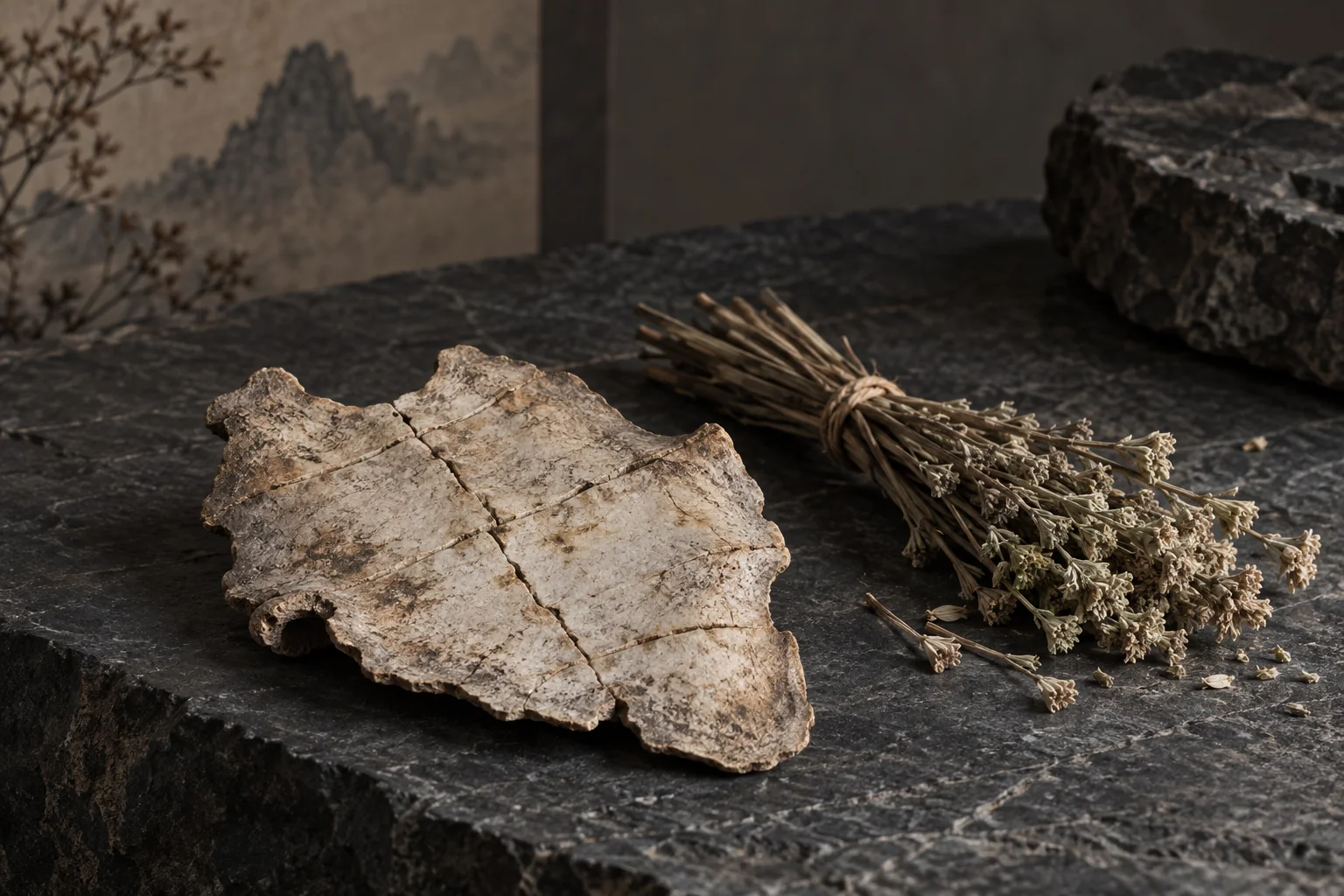
A bone fragment and a bundle of yarrow on dark stone
Bone, bamboo, paper, data. The changing forms of knowledge.

01Origin narratives · Shang–Zhou

Bone, stalks and figures

From narratives of origin to material evidence, traces of divination enter writing and the classics.
A bone fragment and a bundle of yarrow on dark stone
Bone · Yarrow
No determinable historical dateTradition · Text · Debate

Mythic headwaters: Fuxi, the River Chart and Luo Writing

Cultural origin narratives, not archaeological dates

Fuxi drawing the trigrams, the dragon-horse bearing the River Chart and the turtle carrying the Luo Writing form the most influential origin stories of Yijing learning. They reveal how later communities imagined sacred origins, but do not date historical inventions. Familiar diagrams must be traced through Han-Song and later texts.

Myth supplies genealogy; modern research separates genealogy from chronology.
  • Fuxi
  • Hetu-Luoshu
  • pre/post-celestial diagrams
Research sourceStanford Encyclopedia of Philosophy: Chinese change
c. 13th-11th centuries BCEExcavated · Institutional

Questions cut in bone: Shang royal divination

Early Chinese divination becomes a state archive

Anyang oracle bones document an organized late-Shang royal system. Prepared turtle shells and shoulder blades were heated to create cracks; inscriptions recorded dates, diviners, charges, judgments and sometimes accounts of later events across ritual, warfare, weather, harvest, illness and travel.

From ritual act to cumulative political and temporal archive.
  • oracle bones
  • sexagenary dates
  • diviners
Research sourceUNESCO: Chinese oracle-bone inscriptions
Western Zhou through Warring StatesExcavated · Text · Debate

From cracks to stalks: the layered formation of the Zhou Changes

Line statements, techniques and philosophical readings did not arise at once

Numerical hexagrams and Warring States manuals reveal plural divinatory traditions. The line texts and Wings belong to different historical layers; traditional sage genealogy and modern textual stratification should be presented side by side. A manual of divination gradually became a classic of philosophy and ethics.

A divination manual acquires cosmological and ethical layers.
  • sixty-four hexagrams
  • yarrow divination
  • Ten Wings
Research sourceTsinghua University: Shifa and Biegua

02Warring States · Qin–Han · Six Dynasties

Ordering time

Daybooks, calendars and yin-yang and five-phase theories enter daily and institutional life, alongside new approaches to interpreting the classics.
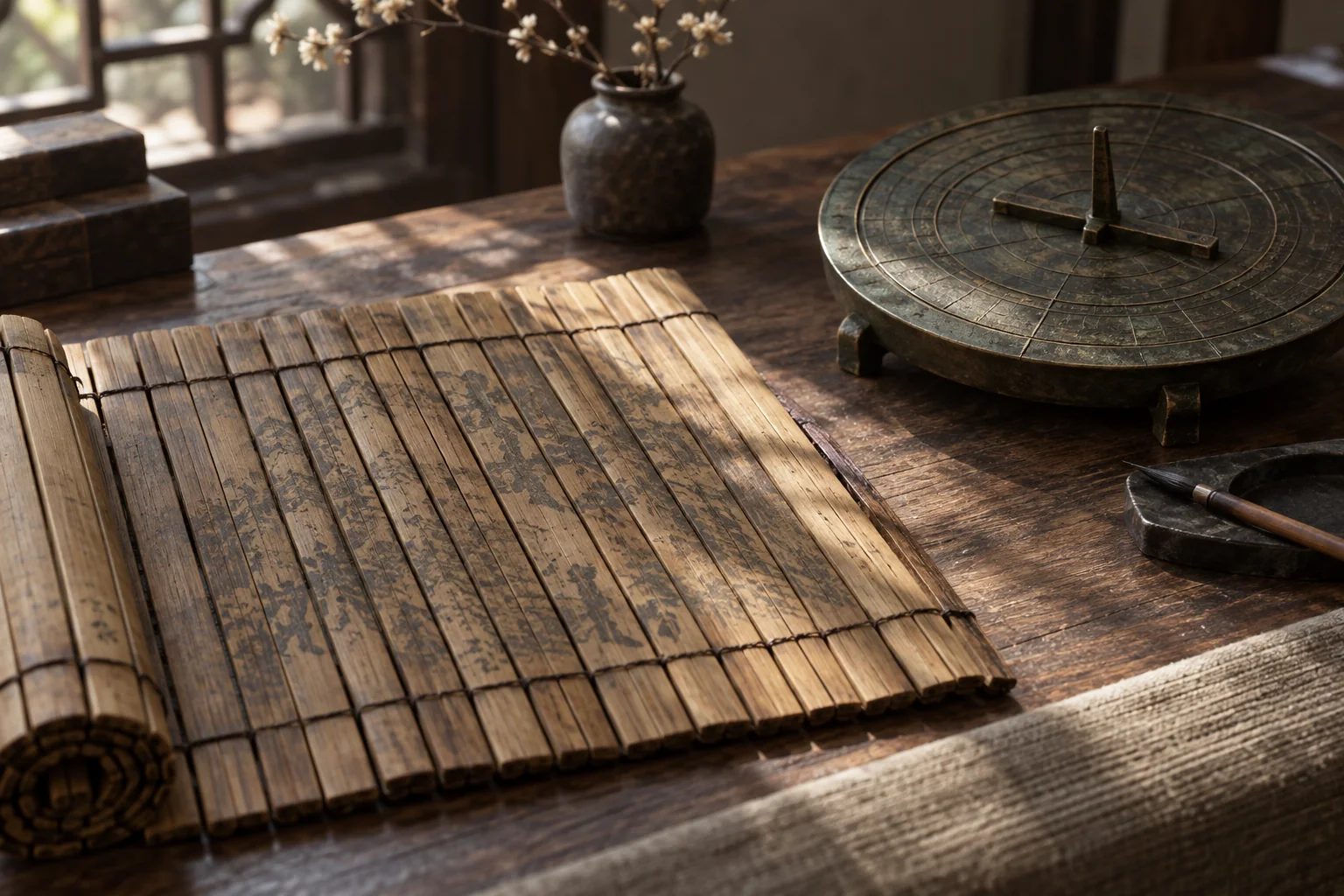
Bamboo slips, binding threads and a bronze disc on a wooden table
Bamboo slips · Divination boards
5th-3rd centuries BCEExcavated · Text

Warring States modeling: yin-yang, phases and daybooks

Mantic arts move from royal decisions into everyday temporal management

Stems-branches, directions, seasons, yin-yang and phases were organized into inferential correspondences. Chu and Qin daybooks show people timing travel, building, marriage, childbirth, illness, farming, trade and burial, with substantial regional variation.

Mantic arts become everyday technologies of time.
  • daybooks
  • five phases
  • date selection
Research sourceAcademia Sinica: research on Qin daybooks
221 BCE-220 CEExcavated · Text · Institutional

Imperial classification: Qin-Han convergence

Astronomy, calendars, phases, divination, omens and forms enter catalogs and bureaus

Qin-Han empires standardized calendars and administrative time. Mawangdui preserves the Changes, planetary omens and cosmic-board texts side by side; the Han bibliography divided shushu into six classes. Han Yijing traditions connected hexagrams, seasons and affairs through hexagram qi, Najia and Eight Palaces.

Scattered techniques enter an imperial order of catalogs, bureaus and commentary.
  • Han bibliography
  • Mawangdui
  • cosmic boards
Research sourceCASS: manuscript mantic arts and the Zhouyi
220-589Text · Debate

Between canon and metaphysics: the Six Dynasties

Philosophical interpretation and technical practice diverge without fully separating

Wang Bi and others recast the Changes in metaphysical terms, while date selection, residence and burial arts, fate calculation and star omenology continued in public and private practice. Later attributions to Guo Pu and other masters require textual scrutiny.

One classic supports intersecting philosophical and technical traditions.
  • Wang Bi
  • xuanxue
  • fengshui

03Sui–Tang · Song

Knowledge in circulation

Manuscripts preserve details of local practice; printing extends circulation and makes new arrangements of knowledge possible.
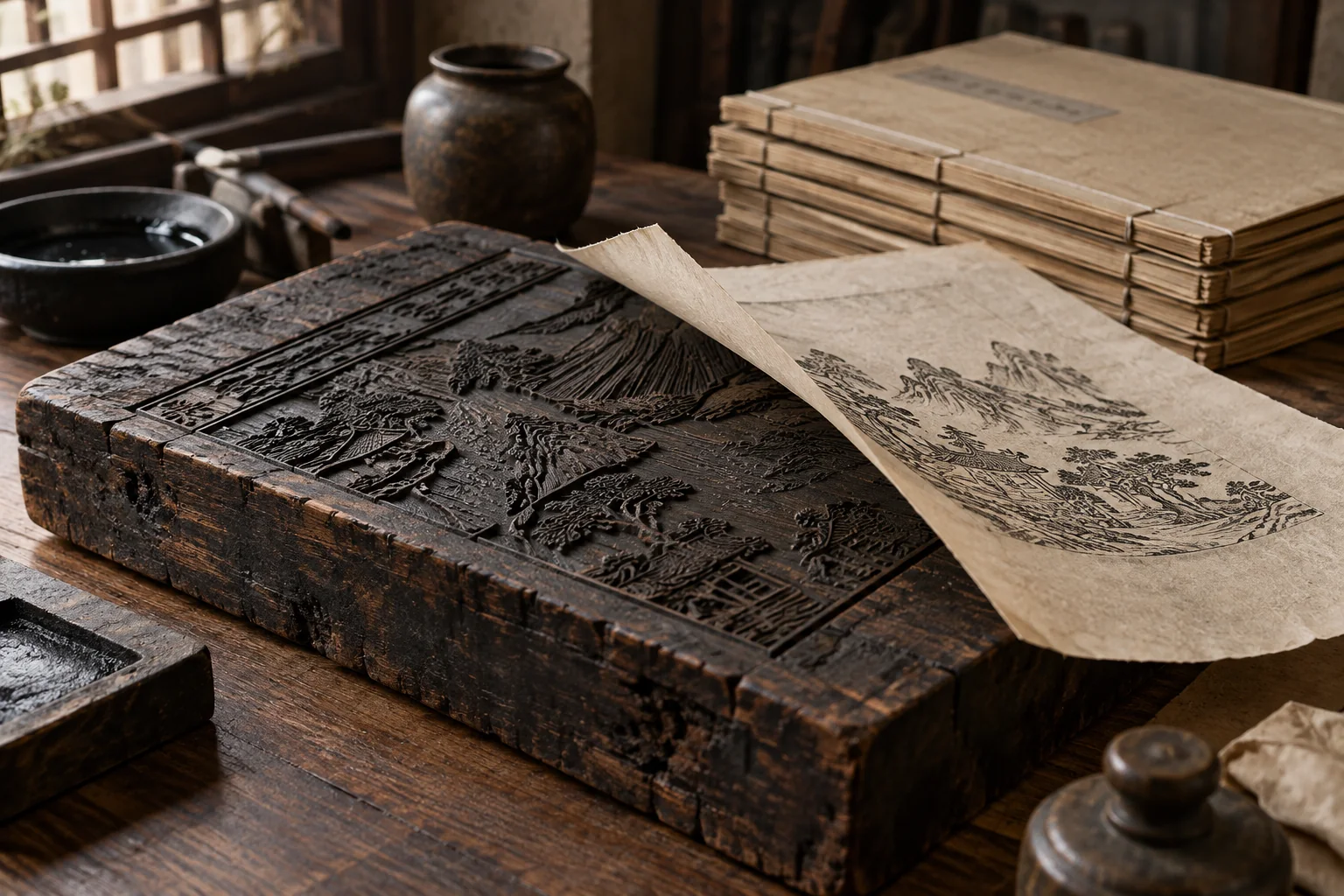
A woodblock, a thin paper sheet and stitched folios
Manuscripts · Woodblocks
589-960Excavated · Institutional · Text

Dunhuang's everyday cosmos: Sui, Tang and Five Dynasties

State institutions, manuscripts and transregional exchange coexist

State offices linked calendars, observation and divination. Hundreds of Dunhuang manuscripts cover cosmic boards, dreams, residences, burials, fates, calendrical taboos and topical divination, showing their role in marriage, production, office, illness and building.

Mantic knowledge circulates through state, temple, market and household networks.
  • Dunhuang manuscripts
  • Court of Imperial Divination
  • cross-cultural astronomy
Research sourceChinese Social Sciences: Dunhuang divination manuscripts
960-1279Text · Institutional

Diagrammatic Yijing and the print revolution: Song

Diagrams, correlative systems, fate calculation and specialist manuals circulate widely

Woodblock printing widened access to classics, medicine, mathematics, astronomy and practical manuals. Shao Yong built a grand temporal system; Hetu-Luoshu and pre/post-celestial diagrams became central. Zhu Xi discussed moral meaning while reaffirming the Changes' divinatory roots.

Manuscript knowledge becomes reproducible, collatable and publicly debated print.
  • Shao Yong
  • Huangji Jingshi
  • diagrammatic Yijing
Research sourceNational Library of China: guide to the Zhouyi

04Yuan · Ming · Qing

Observation and compilation

Astronomical calculation, mantic compilations and textual criticism develop alongside one another, leaving institutional, textual and interpretive records.
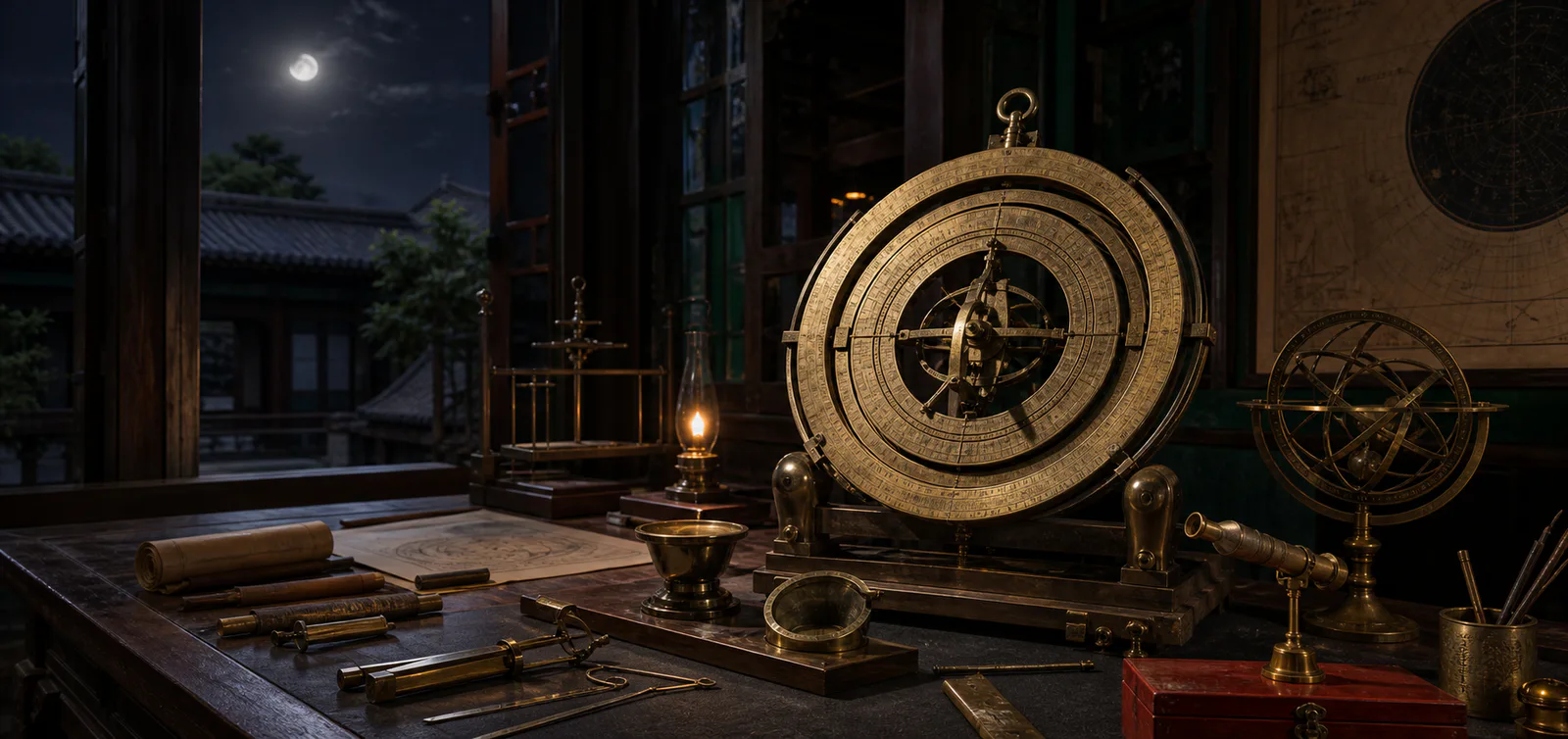
A moonlit study with a bronze instrument and star charts
Observation · Compendia
1271-1368Institutional · Text

Measuring heaven and establishing schools: Yuan

Observation, calculation, local education and political time connect

Guo Shoujing, Wang Xun and collaborators produced the Season-Granting Calendar from wide observation. Local yin-yang schools also held official teaching posts, showing institutional places for calendrical and mantic knowledge amid cross-cultural astronomy.

Technical knowledge enters local schools and professional identities.
  • Season-Granting Calendar
  • yin-yang schools
  • astronomical bureau
Research sourceCambridge: yin-yang school instructors in the Yuan-Ming transition
1368-1644Text · Institutional

Compendia, commercial print and consolidation: Ming

Systems are compiled, repeatedly reattributed and re-edited

The imperial bureau managed astronomy and calendars while commercial print spread almanacs, fate books, cosmic-board, fengshui and physiognomic works. Compendia synthesized earlier material, often under prestigious pseudonyms. Late-Ming calendar reform redrew the border of astronomical calculation.

Systems consolidate as astronomy and prognostication develop new boundaries.
  • commercial print
  • Sanming Tonghui
  • Chongzhen calendar reform
Research sourcePalace Museum: Chongzhen calendrical compendium
1644-1911Institutional · Text

Court compilation, evidential critique and calendars: Qing

Imperial synthesis peaks as epistemic boundaries sharpen

The astronomical bureau continued to absorb European observation and calculation. The Complete Library preserved and criticized mantic works; the Xieji Bianfang Shu synthesized temporal-directional selection. Evidential scholars reexamined Han-Song traditions and later accretions.

Traditional materials are preserved at scale while facing bibliographic and evidential critique.
  • Complete Library
  • Xieji Bianfang Shu
  • evidential scholarship
Research sourcePalace Museum Journal: Xieji Bianfang Shu

05Modern scholarship

Recovery and reassessment

New disciplines and excavated materials change the questions scholars ask. Older texts are recatalogued and intellectual genealogies reassessed.
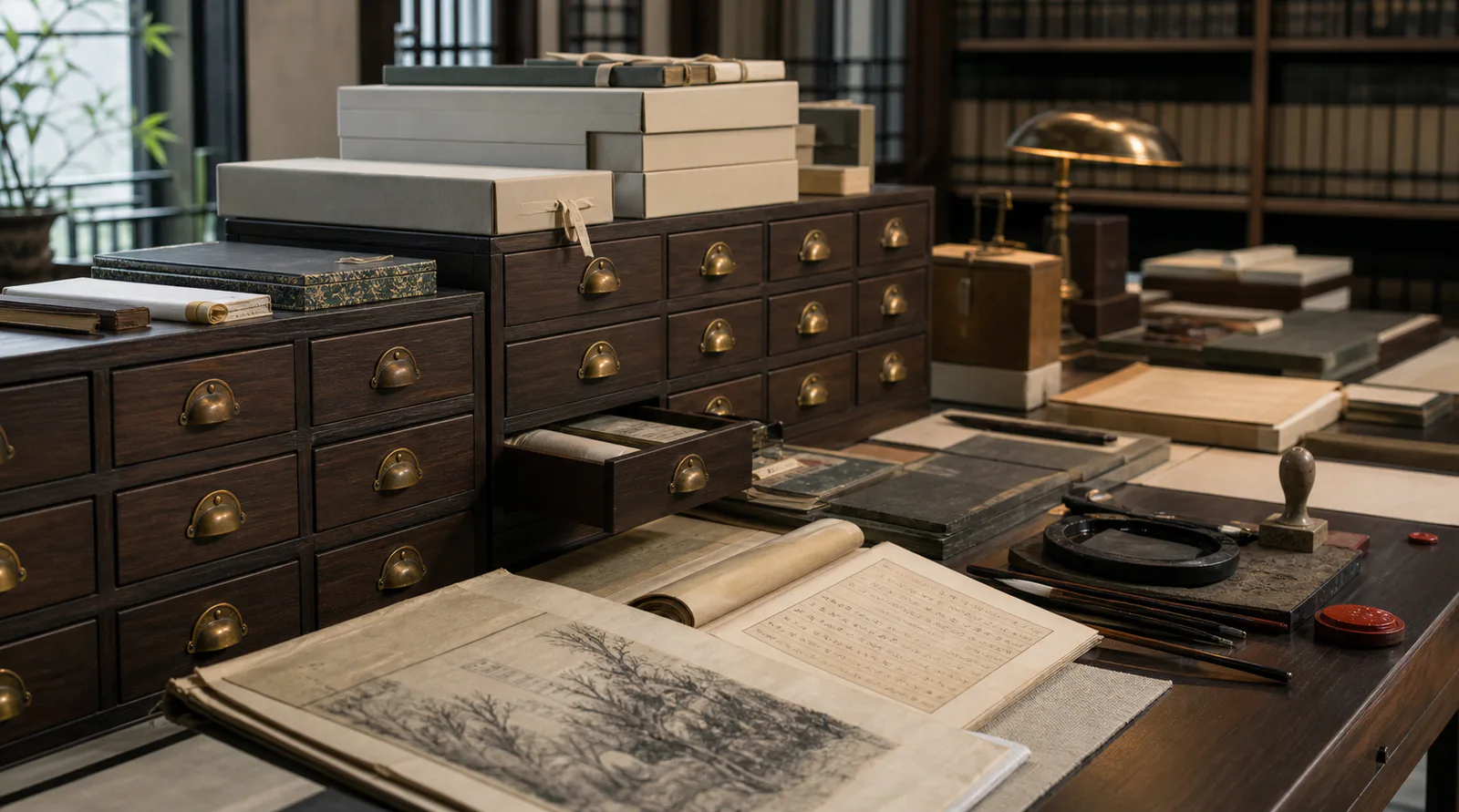
Wooden catalogue drawers, books and an archival table in daylight
Archives · Excavated manuscripts
Late Qing through Republican eraExcavated · Historiography

From inherited practice to modern scholarly object

Oracle-bone studies, archaeology, folklore and mass print transform the field

Oracle bones moved from antiquarian collecting to scientific excavation and paleography, while lithography, newspapers and mass print expanded fate, physiognomy and prophecy books. Scholars combined bones, classical texts and folklore, shifting questions from efficacy toward genealogy, social function and textual formation.

Mantic arts become objects of history, folklore and social science.
  • oracle-bone studies
  • scientific archaeology
  • folklore
Research sourceAcademia Sinica: Anyang excavations
Late twentieth centuryExcavated · Historiography

Manuscripts rewrite the history of mantic arts

Received books meet large corpora of Warring States-Qin-Han manuscripts

Mawangdui, Shuihudi, Guodian, Tsinghua and other discoveries reveal regional and textual forms of the Changes, daybooks, cosmic-board techniques and planetary omenology. Systems imagined as timeless now show layering, divergence and lost branches.

History shifts from received lineages to datable networks of material.
  • Mawangdui
  • Shuihudi
  • manuscript studies
Research sourceChinese Social Sciences: Mawangdui manuscripts

06The present

Into the digital age

Imaging, databases and exchange across languages open new research possibilities, grounded in careful attention to editions and sources.
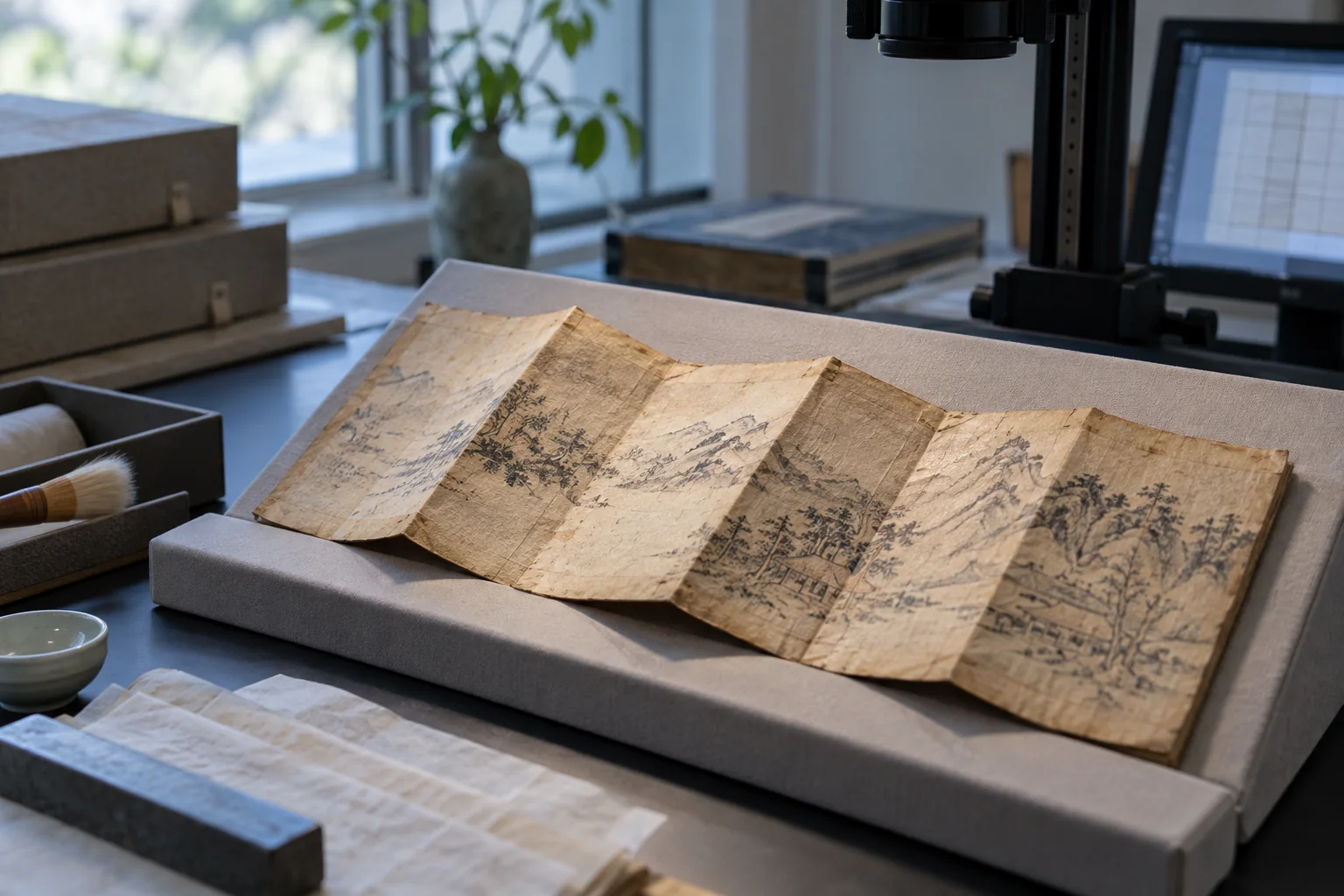
An old paper manuscript on a preservation cradle beneath imaging equipment
Imaging · Data
Twenty-first centuryContemporary research

Digital humanities, living traditions and global circulation

Databases, algorithms and translation create opportunities and amplify distortion

Oracle bones, manuscripts, rare books and mantic texts are being digitized and compared across databases; automated charts reduce calculation barriers and translation broadens audiences. Source erasure, fake antiquity, opaque algorithms, privacy and determinism create new ethical challenges.

Research moves from preservation toward open data, transparent algorithms and cross-cultural responsibility.
  • digital archives
  • knowledge graphs
  • research ethics
Research sourceAcademia Sinica: pre-imperial inscription and manuscript database

07Evidence layers

Historical materials and evidence

Evidence layers assign each statement an appropriate burden of proof while preserving the place of cultural memory.

01

Tradition: cultural memory and later genealogy, not direct chronological evidence.

02

Excavated: supported by archaeological context, dating or verifiable objects.

03

Text: attested in received works, though authorship and dating may remain debated.

04

Institution: documented in bureaus, catalogs, education or state calendars.

Chapter images are AI-assisted editorial artworks. Identification, dating and textual evidence should be traced through the research sources attached to each historical node.

The institute's principles for writing history

01

Myth does not establish chronology

Fuxi, the Yellow Emperor and Hetu-Luoshu retain cultural meaning without serving as archaeological dates.

02

Late attribution does not prove ancient invention

A title page naming Shao Yong, Zhuge Liang or Liu Bowen does not establish authorship of the received algorithm.

03

Observation and omen are distinct evidence

A celestial observation may be accurate while its political prognostication remains a separate historical claim.

04

Cases are not statistical proof

Anecdote, tradition, experience and reproducible testing are reported as distinct categories.