式Mantic arts dossier · The Three Cosmic Boards and spatiotemporal methods
奇门遁甲
Qímén Dùnjiǎ·Qimen Dunjia
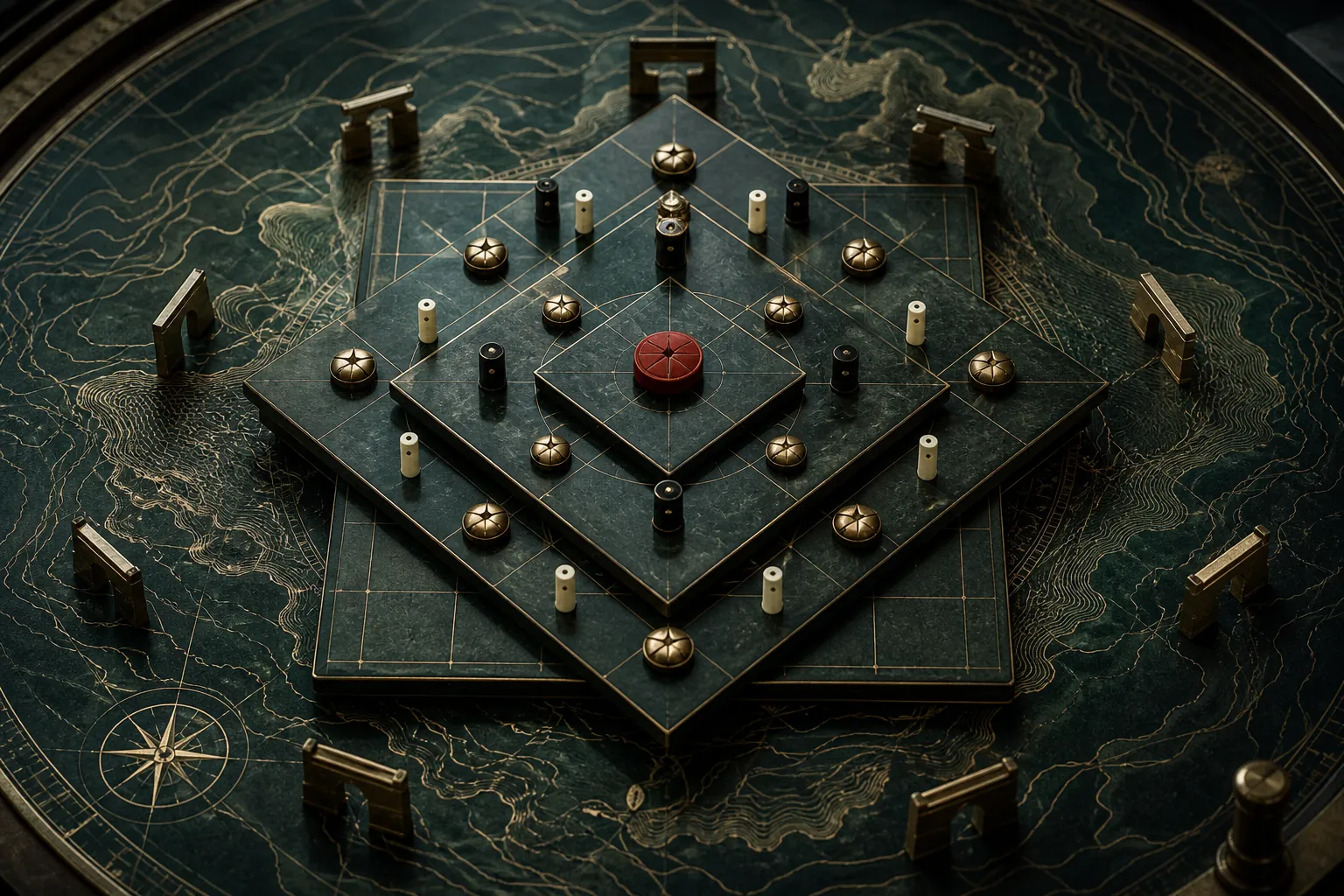
A nine-palace system placing the Three Wonders, Six Instruments, Eight Gates, Nine Stars and spirits according to season, date and yin-yang rotation to analyze timing, direction and action.
- Aliases
- Dunjia, Qimen, Nine-Palace Dunjia
- Formation
- The name Dunjia is Han-attested; received systems formed from Tang-Song through Ming-Qing
- Evidence status
Study notes & citation
奇门遁甲. Institute of Chinese Mantic Arts. https://www.manticarts.com/en/arts/qimen-dunjia
On this page
01Core principles
Core principles
Translate formulas into structure: what enters, how the model is arranged, and which relations drive interpretation.
Season and date determine yin or yang rotation and configuration number, after which earth, heaven, human and spirit layers are arranged. Interpretation centers on day, hour or topic signs and compares palace, gates, stars, spirits, seasonal strength and pattern.
Key concepts
- Three Wonders and Six Instruments
- Eight Gates
- Nine Stars
- yin and yang rotations
02Origins and historical development
Origins and historical development
Keep traditional accounts, surviving evidence and later transformations distinct.
Early Dunjia was closely associated with military omen reading, selection and techniques of direction. Dunhuang and Tang-Song materials show plural layouts; Ming-Qing compilations systematized them, while modern schools include rotating, flying, split-term, intercalary and Maoshan approaches.
STUDY / Qímén Dùnjiǎ
Auditing Qimen board selection
- Materials and inputs
- Time, solar term, dun mode, board convention and arrangement method
Research question
Where do board selection and interpretation diverge?
Practical exercise
For one fictional time, name the intercalation/selection convention before auditing palaces, gates, stars and stems. Keep complete logs for two procedural variants.
03Evidence limits and research debates
Evidence limits and research debates
Distinguish traditional interpretations, documented material and claims requiring testing.
Lineages involving Feng Hou, 1,080 original configurations, Zhuge Liang or Liu Bowen are later narratives. Competing calendrical rules produce different charts; no universally accepted single algorithm exists.
This dossier supports historical, textual and methodological study. Internal traditional explanations are not modern empirical validation and do not replace medical, legal, financial or other professional advice.
04Core texts and materials
Core texts and materials
- 01Dunjia Fuying Jing
- 02Dunjia Yanyi
- 03Imperially Commissioned Qimen Baojian
- 04Dunhuang Dunjia materials