What is the material?
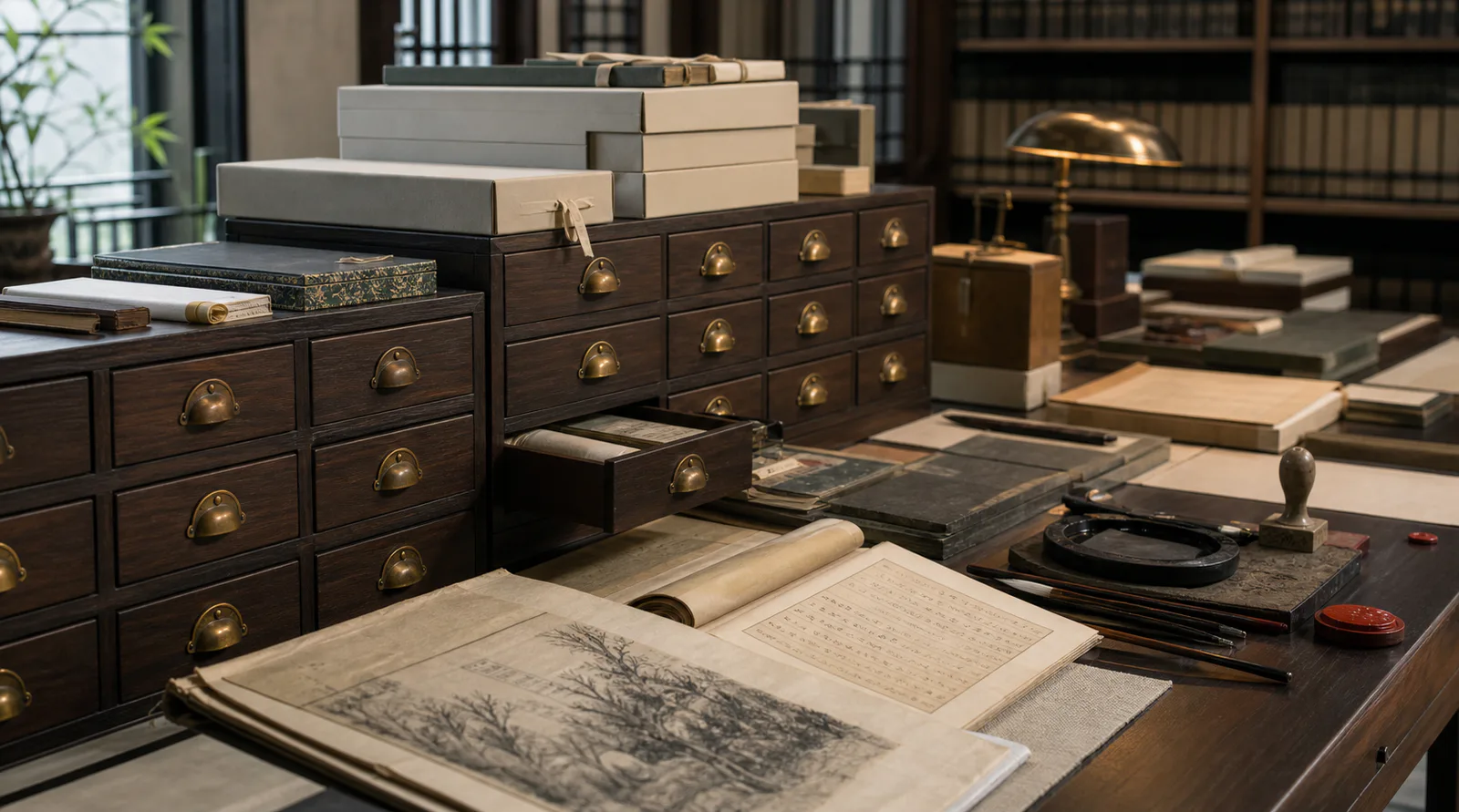
Received edition, excavated manuscript, object, oral account, paper and modern manual support different claims.
LResearch library · source navigator
Primary-text leads, subject literature, historical material and public research resources. Each source retains its related dossier and context for search, comparison and citation.
01Four research routes
One name may belong at once to method, history, text and social practice. These four routes interconnect, but answer different questions.
Check names, aliases, pinyin, family, principles, formation, texts and debates.
Enter 34 dossiers02 · Trace a chronologyUse bones, manuscripts, institutions, print and modern scholarship to distinguish types of evidence.
Open the timeline03 · Clarify a conceptSearch cross-system terms such as image, number, yin-yang, Five Phases, stems-branches, Nine Palaces and Najia.
Search the glossary04 · Conduct researchMove from source layers and textual criticism to algorithm reconstruction and empirical inquiry.
View research methods02Layered reading
The library separates public orientation, specialist study and independent research. You may move quickly, but should not skip checks of terminology, period and source type.
Read atlas summaries, the historical overview and glossary definitions to establish names, periods and families.
For first encounters with Chinese mantic artsEnter a dossier's principles, texts, evidence limits and related systems; record differences among editions and lineages.
For learners with a defined fieldReturn to primary texts, catalogues, archaeology and institutional databases; publish citations, procedures and uncertainties.
For papers, translation, reconstruction and digital projects03Evaluating sources
An institutional page may offer only an introduction; a lineage manuscript may preserve a valuable lead. Evaluation asks exactly what a source can establish, regardless of institutional or lineage status.
Received edition, excavated manuscript, object, oral account, paper and modern manual support different claims.
Separate the date claimed in a text, the surviving edition, attribution and the date of modern cataloguing.
Record chapter, fascicle, page, edition, collection number or a stable link whenever possible.
Layer lineage interpretation, cultural narrative, historical claim and modern validation.
Charts and calculations require inputs, rules, calendar conventions and intermediate steps.
Cases do not generalize automatically; mantic content does not replace medical, legal or financial advice.
04Source catalogue
These links are the sources already annotated in dossiers and the history: museums, universities, research institutes, academic publishers and digital text projects. External content and availability remain under the responsible institution.
Linked entry · 龟卜与骨卜
unesco.orgLinked entry · 龟卜与骨卜
chnmuseum.cnLinked entry · 蓍筮与《周易》
tsinghua.edu.cnLinked entry · 数字卦与先秦筮法
phil.tsinghua.edu.cnLinked entry · 河图、洛书与九宫
zgbk.comLinked entry · 河图、洛书与九宫
dpm.org.cnLinked entry · 卦气、纳甲与八宫
ccj.pku.edu.cnLinked entry · 扬雄《太玄》
gj.scu.edu.cnLinked entry · 皇极经世
chinakongzi.orgLinked entry · 灵棋经
ctext.orgLinked entry · 太乙
chinese.nchu.edu.twLinked entry · 大六壬
philosophychina.cssn.cnLinked entry · 大六壬
chnmuseum.cnLinked entry · 四柱子平命理
newetds.lib.tsinghua.edu.cnLinked entry · 紫微斗数
airitilibrary.comLinked entry · 七政四余与五星星命
ihp.sinica.edu.twLinked entry · 七政四余与五星星命
ctext.orgLinked entry · 国家星占与天象占候
dpm.org.cnLinked entry · 风角、云气与物候杂占
cssn.cnLinked entry · 堪舆与风水
rwsk.zju.edu.cnLinked entry · 堪舆与风水
img.dpm.org.cnLinked entry · 相人术
iahs.fudan.edu.cnLinked entry · 择日与选择术
lac.cqu.edu.cnLinked entry · 择日与选择术
dpm.org.cnLinked entry · 测字、拆字与相字
journal.ccnu.edu.cnLinked entry · 五兆卜法与敦煌事项占
csspw.com.cnLinked entry · 谶纬、图谶与预言文献
zgbk.comLinked entry · 谶纬、图谶与预言文献
lhp.sdu.edu.cnLinked entry · Mythic headwaters: Fuxi, the River Chart and Luo Writing
plato.stanford.eduLinked entry · Warring States modeling: yin-yang, phases and daybooks
www1.ihp.sinica.edu.twLinked entry · Imperial classification: Qin-Han convergence
lishisuo.cssn.cnLinked entry · Diagrammatic Yijing and the print revolution: Song
nlc.cnLinked entry · Measuring heaven and establishing schools: Yuan
cambridge.orgLinked entry · From inherited practice to modern scholarly object
museum.ihp.sinica.edu.twLinked entry · Manuscripts rewrite the history of mantic arts
cssn.cnLinked entry · Digital humanities, living traditions and global circulation
w9.ihp.sinica.edu.tw05Citation record
When pages, editions or interpretations change, a clear record lets you and later readers retrace the same evidentiary path.