
式Mantic arts dossier · The Three Cosmic Boards and spatiotemporal methods
太乙
Tàiyǐ·Taiyi cosmic-board calculation
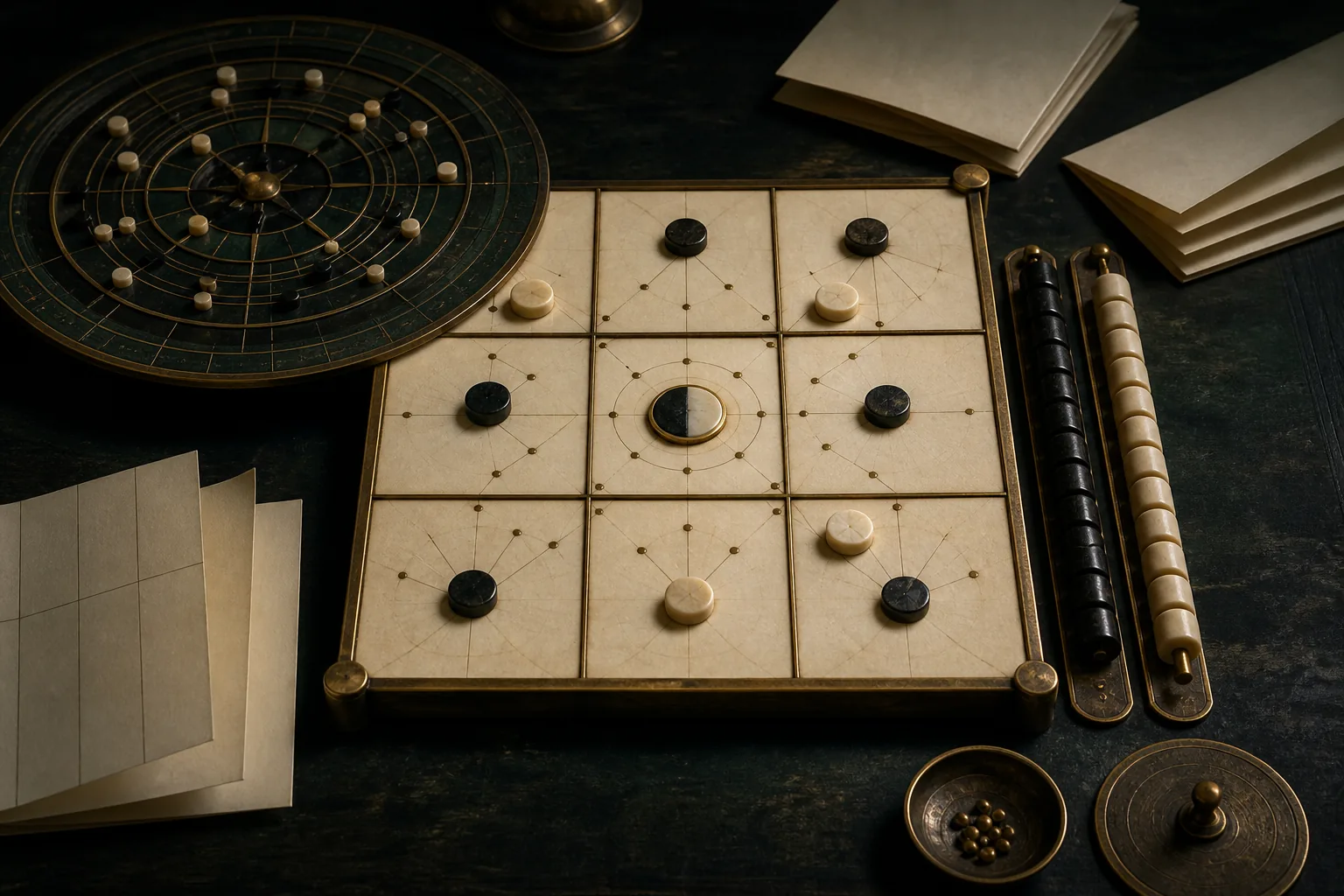
One of the Three Boards, arranging Taiyi and associated agents through accumulated years, epochs, nine palaces and configurations, traditionally for state affairs, warfare, disasters and long-term cycles.
- Aliases
- Taiyi calculation, Taiyi board method
- Formation
- Han bibliographic traces; full received systems chiefly visible after the Tang-Song
- Evidence status
Study notes & citation
太乙. Institute of Mantic Arts. https://www.manticarts.com/en/arts/taiyi
On this page
01Core principles
Core principles
Translate formulas into structure: what enters, how the model is arranged, and which relations drive interpretation.
An epoch and accumulated-year calculation yields a configuration; Taiyi, Wenchang, Shiji and host-guest generals are placed in palaces and read through interior-exterior, host-guest and positional relations.
Key concepts
- epoch and accumulated years
- nine palaces
- host and guest
- cosmic agents
02Origins and historical development
Origins and historical development
Keep traditional accounts, surviving evidence and later transformations distinct.
The Han bibliography lists a Taiyi-yinyang work, but early Taiyi cult, bibliographic traces and the received algorithm cannot be assumed to form an unbroken line. Tang-Song sources grouped Taiyi with Qimen and Liuren; Ming compilations enlarged the corpus.
TEXT / METHOD / EVIDENCE
Accumulated years, alternate palaces and host–guest structure
Taiyi Jinjing Shijing combines calendrical calculation, palace assignments, named agents and political interpretation. Follow separately how numbers become positions, how positions form relations and how interpretation depends on historical context.
Tang attribution and a Qing witness
The Siku abstract lists ten juan under Wang Ximing of the Tang, while noting calculations reaching the Song's Jingyou first year and treating them as later additions. That is an editorial observation about textual layers. Record both the attributed author and this qualification; the surviving work's title-page attribution does not establish a Tang date for every passage.
The Digital Archives catalogue identifies the Palace Museum witness as 故庫018063–018064, shelf location 3133: two bound volumes of the Wenyuan Pavilion Siku edition copied during Qianlong's reign. Ten juan and two bound units describe different structures; Tang attribution and Qing copying describe different dates. This review uses catalogue metadata and online transcription, without folio-by-folio collation of the museum witness.
Epoch counts and successive remainders
Volume one's epoch passage discusses competing starting points and counts. Its later statement associates Kaiyuan year 12, Jia-Zi, with 1,937,281 accumulated units. That is a count from an adopted epoch to a reference year, not a civil-year label or a date for the physical book. Preserve the reference statement beside the number before attempting a conversion.
The placement procedure successively uses 360, 72, 24 and 3. Keep dividend, quotient and remainder in separate columns: 1,937,281 leaves 121 on division by 360; 121 leaves 49 on division by 72; 49 leaves 1 on division by 24. This establishes the remainder chain only. Translating a remainder into a palace also requires an explicit interpretation of counting origin and exact-division cases.
Nine Palaces with different numbering
Volume two first describes the familiar nine-above, one-below pattern, then specifies Taiyi assignments: Qian 1, Li 2, Gen 3, Zhen 4, Dui 6, Kun 7, Kan 8 and Xun 9. Directions and trigram names can remain fixed while palace numbers differ. Taiyi palace 1 is northwest at Qian; Luoshu palace 1, as used in the Qimen experiment, is north at Kan.
Both comparison diagrams face south at the top. Taiyi reads 9–2–7, 4–5–6, 3–8–1; Luoshu reads 4–9–2, 3–5–7, 8–1–6. Centre 5 remains a coordinate reference but is excluded from the displayed Taiyi traversal. This comparison concerns the numbered assignments in the cited text. It does not collapse every historical use of Nine Palaces into an unversioned universal board.
Three-year residence and four time scales
Volume two describes movement through eight palaces, excluding centre 5, with three years in each. It labels those years governance of heaven, earth and people. That residence pattern gives 24 year-positions in one circuit. The experiment begins at palace 1's first year: position 3 remains there, 4 enters palace 2, 12 lies in palace 4 and 13 moves to palace 6.
Volume one separately develops monthly, daily and hourly methods, including accumulation and solstitial conditions. Similar divisors or palace steps do not make their input units interchangeable. Three years, months, days and hours require their respective textual rules. The small-cycle experiment illustrates the three-year residence pattern of volume two; it is not applied automatically to the current date.
Sixteen stations, Tianmu and unequal cycles
The sixteen-agent section interleaves the twelve branches with Gen, Xun, Kun and Qian and assigns names such as Dizhu, Yangde, Hede and Lüshen. This creates a sixteen-position reference system. It can be related to the eight-palace traversal and twelve-branch cycle, but each system retains its own size, origin and direction in a research record.
The Tianmu procedure in volume one uses a cycle of 18, starting from Wude and adding an extra count at Yinde and Dawu. Sixteen stations and eighteen counts differ because of residence rules. Substituting either number into one undifferentiated remainder formula would lose that distinction. The reference table preserves names and stations without presenting an undeclared full-agent chart.
Host and guest as conditional roles
The host–guest passage in volume four defines roles through precedence and movement. In its field-array scenario the first mover is guest and the responder host; in its settled-position scenario the first mover is host and the responder guest. Before reading a statement about either role prevailing, identify the definition in force. Modern labels such as our side and their side cannot simply replace those conditional roles.
The adjacent mutual-restriction passage adds phase relations and examples involving Gaochong and Taicu, or Yinzhu and Dizhu. Position, assigned phase, host–guest status and interpretation form distinct layers. A textual exercise can vary one condition and trace the resulting label change. This analyses dependencies within a historical procedure; it supplies no practical advice for real conflict.
Political interpretation and checkable claims
The Siku abstract criticises historical correspondences and territorial assignments while retaining the work for its place among the Three Boards and its transmission history. Read the treatise and the editorial response together: how does the former connect cosmic order with rulership, and from what position does the latter object? Each is an attributable historical argument whose evidence still needs examination.
Reconstruction has several checkable outcomes: arithmetic agreement, coordinate agreement, matching rule selection and accurate reporting of interpretation. Predictive claims about disasters, warfare or long-term political change require separately defined samples, horizons, failure criteria and complete outcomes. A chart can be reconstructed correctly without that procedural result establishing every associated claim.
COORDINATES / 024
Alternate palace numbers and a 24-position circuit
Advance the circuit to locate Taiyi on the left. The right diagram highlights the same number in Luoshu. Shared orientation makes palace number, trigram position and traversal distinct.
Taiyi numbers: Qian · NW
Luoshu numbers: Kan · N
South above · North below
Positions 12 → 13: palace 4 → 6, skipping centre 5. This circuit ends at position 24; return to the first to compare again.
Nine-Palace coordinate table
| South above · North below | Taiyi numbers | Luoshu numbers |
|---|---|---|
| Xun · SE | 9 | 4 |
| Li · S | 2 | 9 |
| Kun · SW | 7 | 2 |
| Zhen · E | 4 | 3 |
| Centre · Centre | 5 | 5 |
| Dui · W | 6 | 7 |
| Gen · NE | 3 | 8 |
| Kan · N | 8 | 1 |
| Qian · NW | 1 | 6 |
Original teaching diagram based on volume two's palace numbers and three-year residence. The origin is fixed at palace 1, year 1. It does not convert actual dates, calculate Tianmu or host–guest counts, place every agent or replicate an artefact.
Sixteen named stations and Tianmu residence notes
| Station | Textual name | Count note |
|---|---|---|
| Zi | 地主 | — |
| Chou | 阳德 | — |
| Gen | 和德 | — |
| Yin | 吕申 | — |
| Mao | 高丛 | — |
| Chen | 太阳 | — |
| Xun | 太炅 | — |
| Si | 太神 | — |
| Wu | 大威 | — |
| Wei | 天道 | — |
| Kun | 大武 | One extra count |
| Shen | 武德 | Start at Wude |
| You | 太蔟 | — |
| Xu | 阴主 | — |
| Qian | 阴德 | One extra count |
| Hai | 大义 | — |
The table starts at Zi to list branches and corners; Tianmu's counting origin is Wude. Display order and procedural origin are labelled separately. This reference does not replace the full Tianmu procedure.
A three-row accumulated-count calculation
Using the stated 1,937,281, display the first three remainder operations, without calendar conversion or boundary-year assignment.
| Dividend | Divisor | Quotient | Remainder |
|---|---|---|---|
| 1,937,281 | 360 | 5,381 | 121 |
| 121 | 72 | 1 | 49 |
| 49 | 24 | 2 | 1 |
One action order, two role definitions
| Scenario | First mover | Responder |
|---|---|---|
| Field array | Guest | Host |
| Settled position | Host | Guest |
Roles depend on the stated conditions; this table supports historical textual comparison.
A four-step research record
Identify the witness
Keep attribution, ten textual divisions, two bound volumes, identifiers and copying period separate.
Declare the input unit
Identify accumulated years, months, days or hours, retaining origin, raw count and remainder chain.
Compare positions and cycles
Fix directions and trigrams, then assign numbers; check eight palaces, twelve branches, sixteen stations and residence rules separately.
Reconstruct interpretive conditions
Identify the role definition, relation and textual locator before recording interpretation; retain unresolved assumptions.
WORKED EXAMPLE
From material to claim
Original exercise: keep the south-up layout and compare small-cycle positions 12 and 13. Each palace holds three years; the traversal is 1, 2, 3, 4, 6, 7, 8, 9.
Position 12 is the third year in palace 4, Zhen in the east. Position 13 is the first year in palace 6, Dui in the west, skipping centre 5. Applying Luoshu numbers instead would misplace 4 in the southeast and 6 in the northwest.
- Does position 13 skip palace 5?
- Which numbering supplies the direction?
- Has a teaching position been mistaken for a dated year?
Review questions
Is 1,937,281 a civil year?
It is a count from a specified epoch to a reference year. Conversion needs that origin and counting convention.
Are both Taiyi 1 and Luoshu 1 in the north?
The cited Taiyi text places 1 at Qian in the northwest; Luoshu places it at Kan in the north. Keep the system label with the number.
Why can sixteen stations use an eighteen-count Tianmu cycle?
Volume one specifies an additional count at Yinde and Dawu. Number of stations and length of the count differ.
Does first mover means guest apply to every stated context?
Volume four also gives a settled-position context where the first mover is host. Retain scenario and condition with the role assignment.
Does the abstract's later-addition observation erase every Tang attribution?
It signals textual layers, not a single date for every passage. Individual sections still need edition comparison.
STUDY / Tàiyǐ
The calculation chain of Taiyi
- Materials and inputs
- Accumulated-year convention, board parameters, agents and edition
Research question
At which step does a different epoch change the arrangement?
Practical exercise
Diagram dependencies for one published procedure. Reconstruct adjacent years and flag steps not uniquely specified by the text.
Close readingThe Liuren earth plate: reading an incomplete objectStudy pathCosmic boards: objects and procedures03Evidence limits and research debates
Evidence limits and research debates
Distinguish traditional interpretations, documented material and claims requiring testing.
Epochs, configuration rules and agent names differ across texts. Invention by the Yellow Emperor is a lineage claim, not a historical authorship finding.
This dossier supports historical, textual and methodological study. Internal traditional explanations are not modern empirical validation and do not replace medical, legal, financial or other professional advice.
04Core texts and materials
Core texts and materials
- 01Taiyi Jinjing Shijing
- 02Taiyi Tongzong Baojian
- 03Relevant entries in the Han bibliography