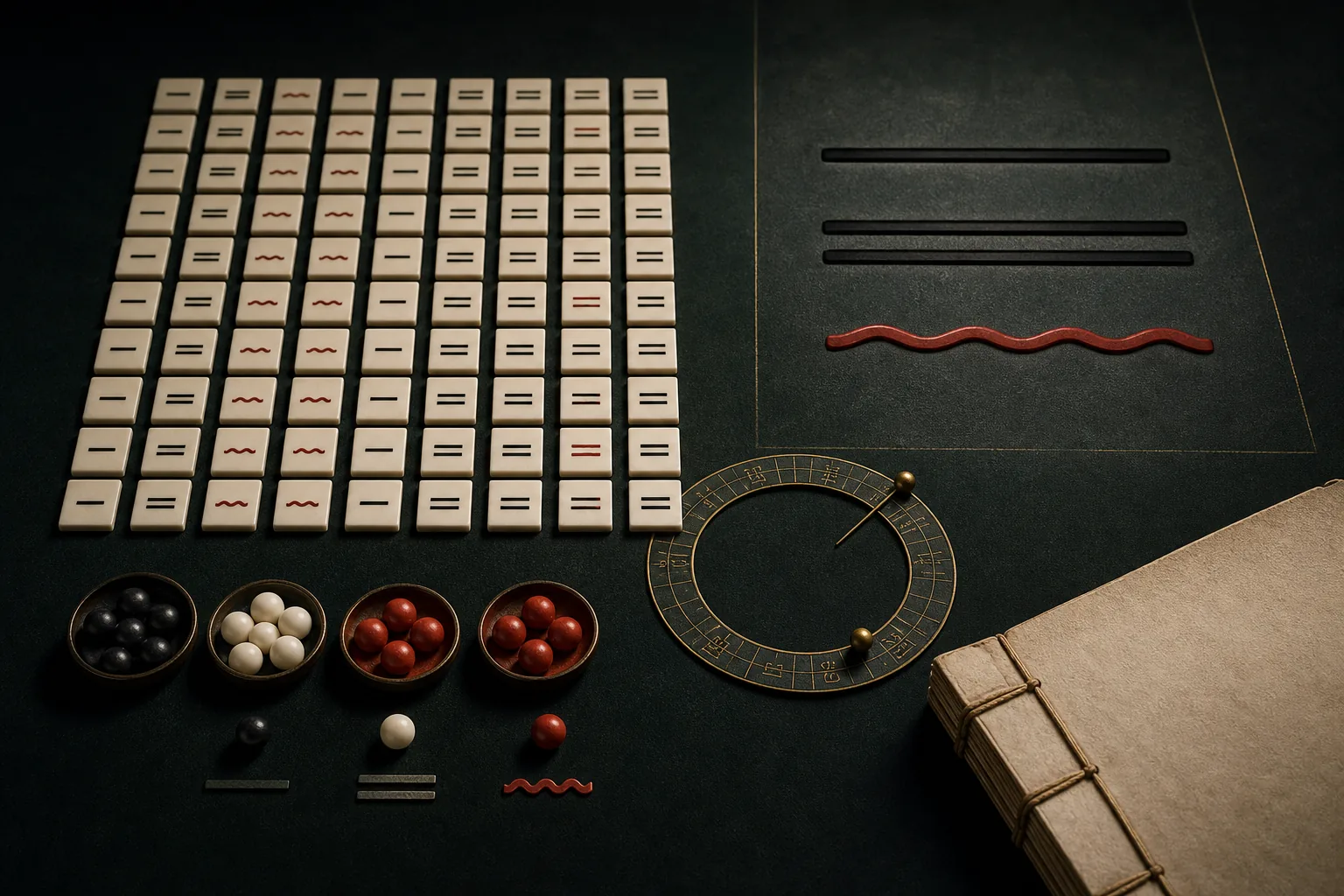
《焦氏易林》
Jiāoshì Yìlín · The Forest of Changes
A corpus of more than four thousand rhymed oracles indexed by primary and resulting hexagrams, valuable as divination manual, poetry, folklore and Han social evidence.
L.01MANTIC ARTS LIBRARY
Thirty-four core dossiers across nine families. Explore principles, formation, primary texts, school differences and the limits of evidence.

Jiāoshì Yìlín · The Forest of Changes
A corpus of more than four thousand rhymed oracles indexed by primary and resulting hexagrams, valuable as divination manual, poetry, folklore and Han social evidence.
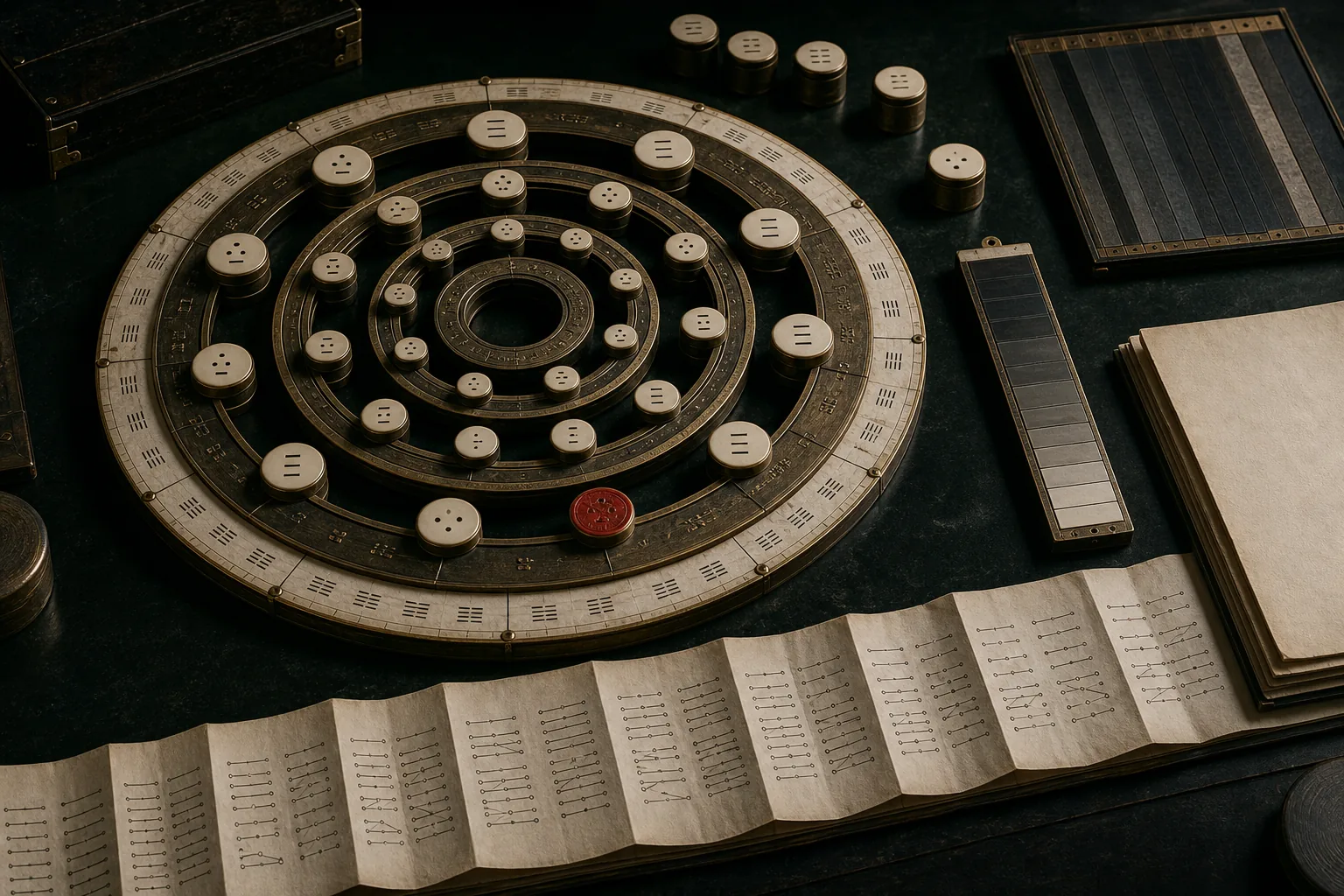
Yáng Xióng Tàixuán · Yang Xiong's Canon of Supreme Mystery
Yang Xiong's ternary symbolic cosmology of eighty-one tetragrams and 729 appraisals, coordinated with calendar, seasons and phases: modeled on the Changes yet independent.
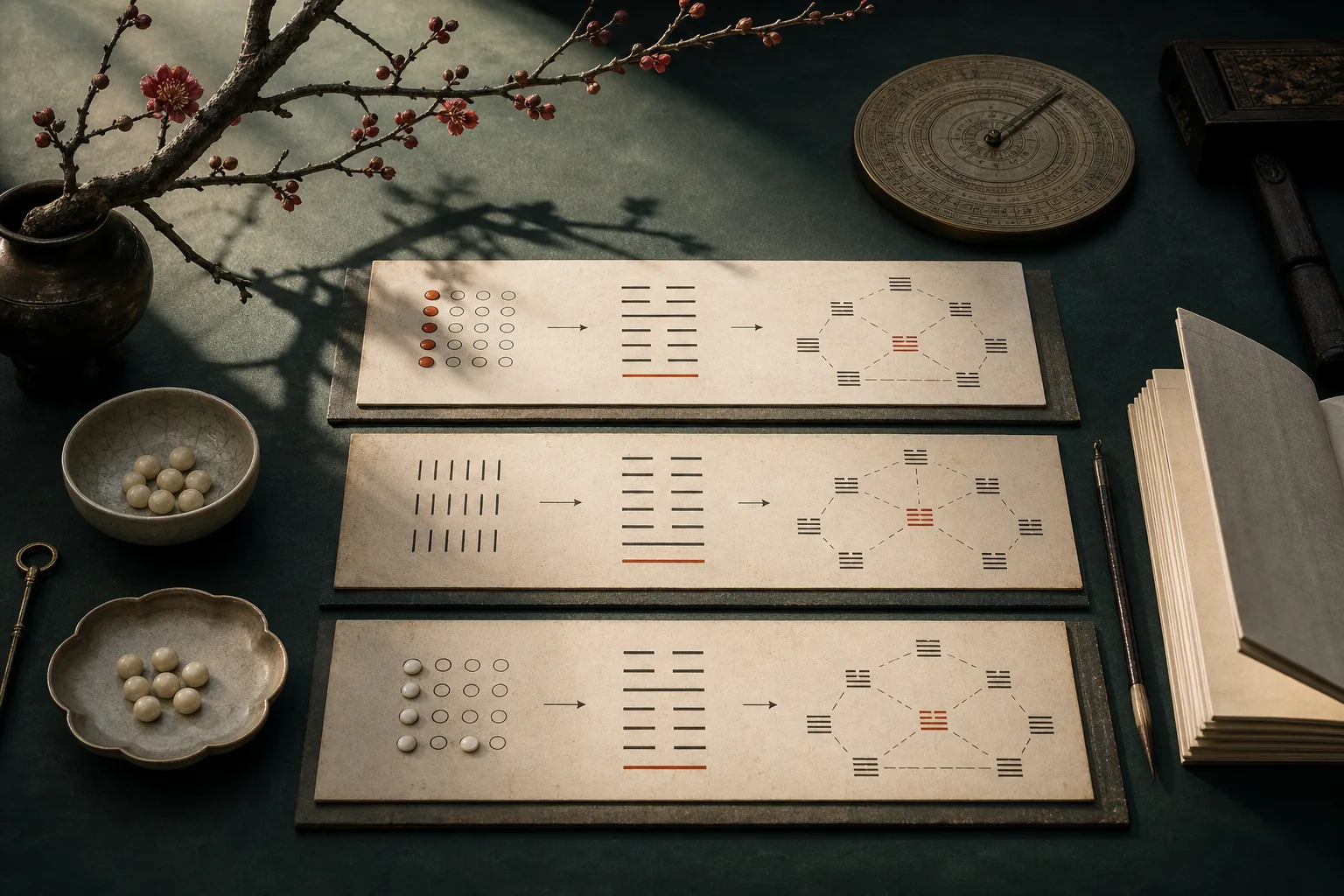
Nàjiǎ Liùyáo · Six-Line Najia divination
A hexagram method assigning branches, phases, six relations, host-response positions and six spirits, then reading season, day, change and strength; one of the most active Yijing divination systems today.
Méihuā Yìshù · Plum Blossom Numerology
A flexible method taking hexagrams from time, numbers, sound, direction, characters or encountered images and interpreting change through body-function roles, phase relations, nuclear hexagrams and external correspondences.
Huángjí Jīngshì · Supreme Principles Governing the World
A model of cosmic and historical time using pre-celestial hexagram orders and nested yuan-hui-yun-shi cycles, connecting correlative number, sound, history and political change.
Héluò Lǐshù · Hetu-Luoshu Principle and Number
A Ming-Qing system converting birth stems and branches into heaven-earth numbers and pre/post-celestial natal hexagrams, then using an original line and temporal changes to interpret life stages.
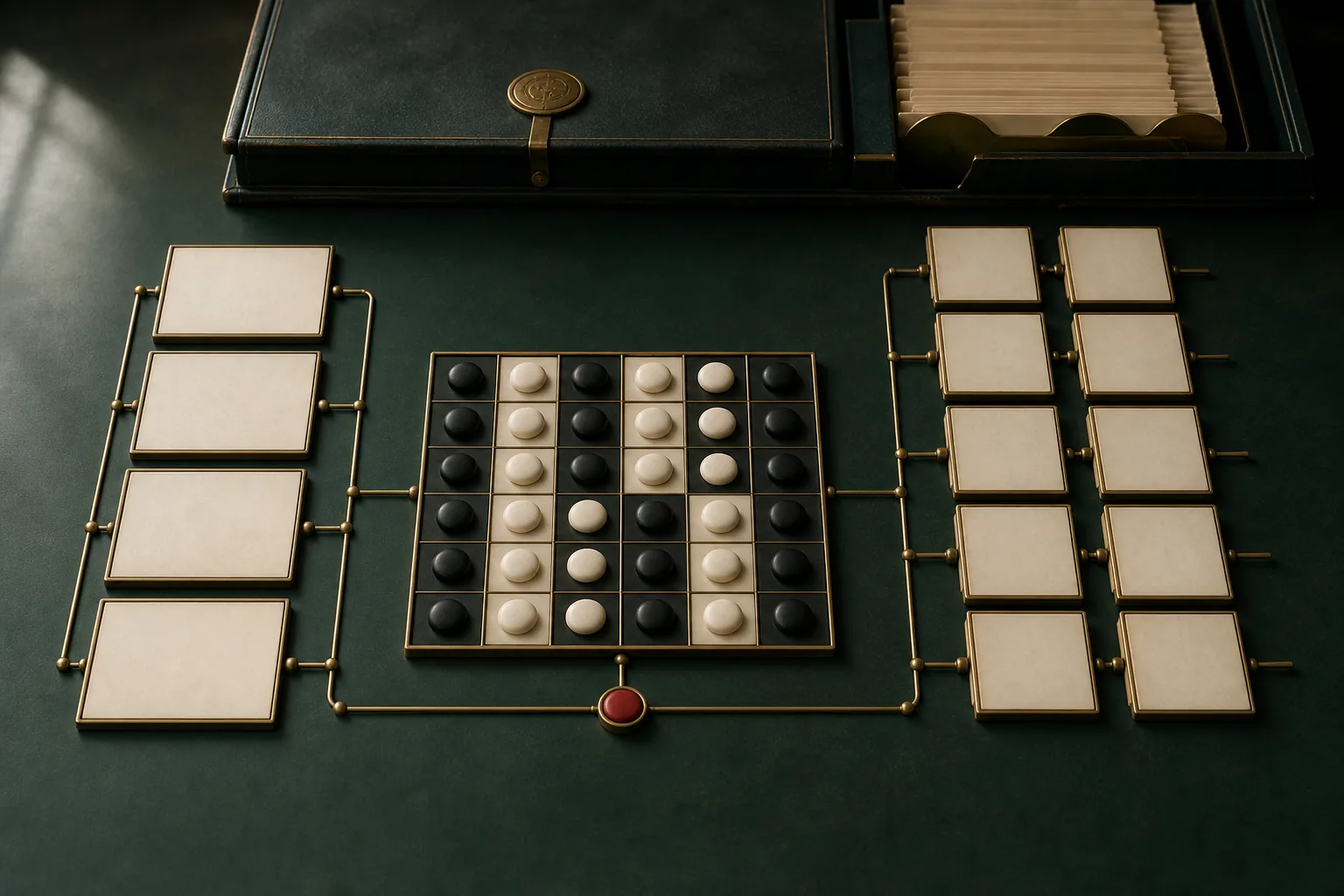
Língqí Jīng · Classic of Spirit Tokens
Twelve marked tokens are cast into upper, middle and lower groups to form one of 125 figures with an attached oracle; an independent compact method widely transmitted in medieval times.
CONNECTED KNOWLEDGE
Each path connects a family, shared questions and related fields for comparative reading, without claiming proven historical transmission.
02KNOWLEDGE FAMILIES

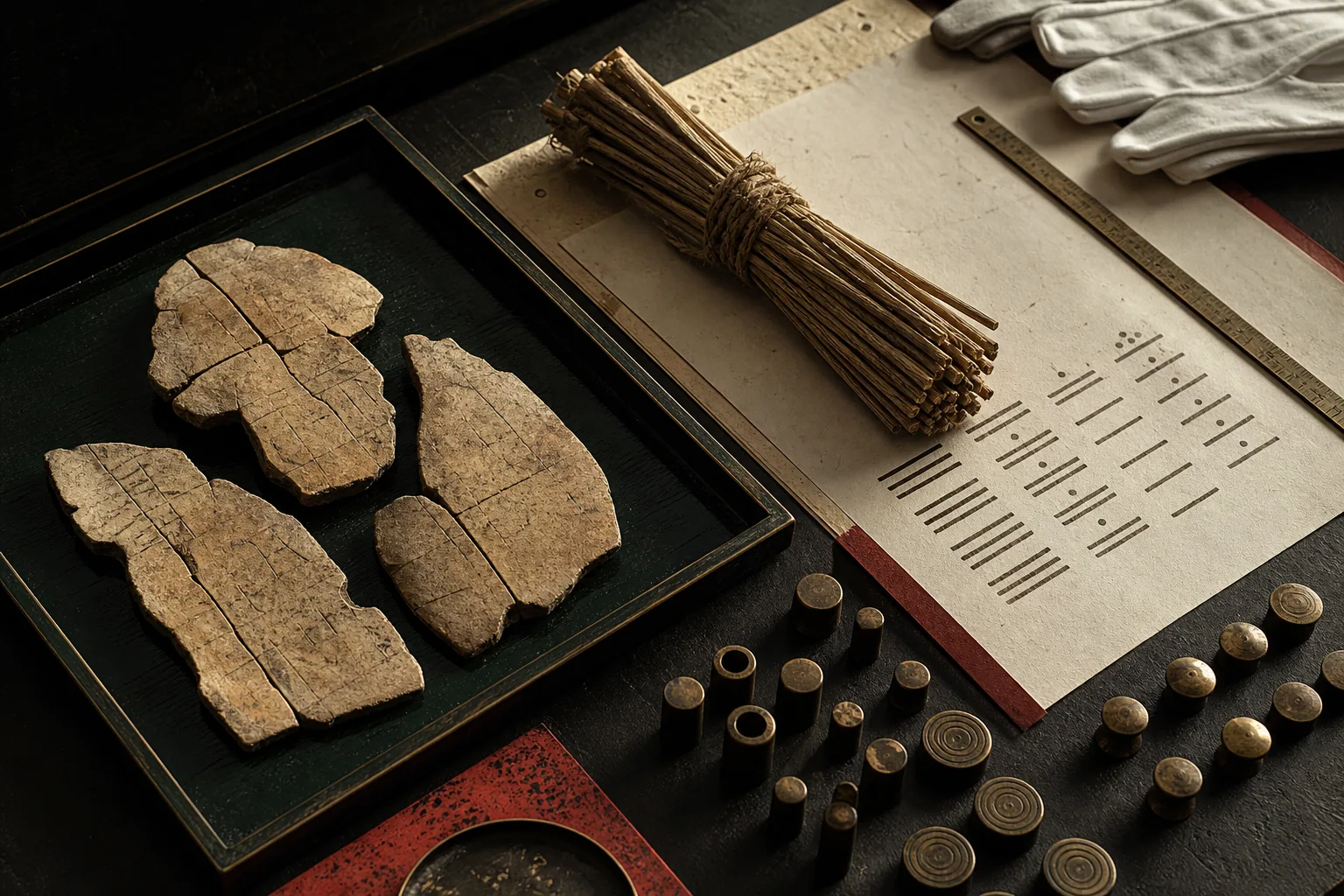
From oracle bones, yarrow and numerical hexagrams to Hetu-Luoshu and Najia: the symbolic, temporal and numerical languages shared by many later systems.

Distinct traditions of inference built around hexagrams, lines, correlative roles, oracular texts and large-scale models of time.

Taiyi, Qimen, Liuren and related methods organize time and space through nine-palace models, cosmic boards, agents and calendrical rules.

Traditional interpretive systems organizing life narratives through birth time, stems and branches, palaces or celestial positions.

From state astrology to winds, cloud forms and phenology: how observations became political and human interpretation.

Approaches to dwellings, graves, settlements and landscapes through form, orientation, timing and spatial order.

Historical systems of classification and analogy based on appearance, bones, voice and movement, studied together with their risks of bias.

Traditions matching activities with calendrical days, seasonal nodes, the Twelve Officers and other almanac factors.

Lots, moon blocks, character analysis, dream books and local quick methods reveal the diversity of divination in everyday life.
03Scope and classification
No closed, universally accepted list covers every Chinese mantic art. Names overlap, divide, disappear, acquire pseudonymous authors and are reinvented. This atlas centers identifiable texts, living systems and significant branches, with its scope and evidence levels made explicit.
Supported by datable material, catalogs, objects or verifiable text.
How a lineage or book tells its story; not automatically a modern historical finding.
A culturally meaningful origin narrative that does not establish a date.
Disagreement over author, composition, genealogy or algorithmic relationship.
04Branch index and extended dossiers
These names remain in a traceable branch index. They become independent dossiers only when rules, dates and relationships can be described with adequate evidence.
Six Lines: Huozhulin, Wenwangke, Huangjin Ce, hidden lines, advancing-retreating signs and timing schools
Qimen: rotating, flying, split-term, intercalary, Maoshan, hourly, daily and selection approaches
Liuren: lesson-pattern, correlative, case-based, Golden Formula and the genealogically uncertain Lesser Liuren
Fate calculation: nayin luming, Ziping pattern, strength, climatic adjustment, spirits, Taiyi natal methods, nine-palace annual movement and hand mnemonics
Astral nativities: Qintang, Guolao, celestial-office planets, Seven Governors and Four Auxiliaries, animal-star and lodge traditions
Fengshui: form, Sanhe, Sanyuan, Xuankong, Flying Stars, Eight Mansions, living and burial approaches and compass layers
Physiognomy: face, bone, hand, voice, gait, complexion and moles, with cross-cultural origins marked where needed
Miscellaneous methods: hidden-object guessing, inverse puncture, emptiness, animal calls, bodily signs, anomalies, board games, coins, dominoes and dice